












Although Arabic is Oman's official language, there are native speakers of different dialects, as well as Balochi (the language of the Baloch from Pakistan), or offshoots of Southern Arabian, a Semitic language only distantly related to Arabic, but closely related to Semitic languages in Eritrea and Ethiopia. Swahili and French are also widely spoken in the country due to the historical relations between Oman and Zanzibar the two languages have been linked historically. The dominant indigenous language is a dialect of Arabic and the country has also adopted English as a second language. Almost all signs and writings appear in both Arabic and English. A significant number also speak Hindi, due to the influx of Indian migrants during the late 1980s and the 1990s.
Oman is famous for its khanjar knives, which are curved daggers worn during holidays as part of ceremonial dress. Today traditional clothing is worn by most Omani men. They wear an ankle-length, collarless robe called a dishdasha that buttons at the neck with a tassel hanging down. Traditionally this tassel would be dipped in perfume. Today the tassel is merely a traditional part of the dishdasha.
Women wear hijabs and abayas. Some women cover their faces and hands, but most do not. The abaya is a traditional dress and it is currently having different styles. The Sultan has forbidden the covering of faces in public office. On holidays, such as Eid, the women wear traditional dress, which is often very brightly colored and consists of a mid-calf length tunic over pants.
A very important part of Omani culture is hospitality. If invited into an Omani house, a visitor is likely to be greeted with a bowl of dates, qahwa (coffee with cardamom - standard Arabic قهوة) and fruit. The coffee is served fairly weak in a small cup, which should be shaken after three servings to show that you have finished. The dates are in lieu of sugar. Halwa and other sweets are often given at celebrations such as Eids.
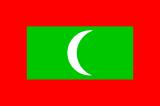
The Maldives
The Republic of the Maldives, is a collection of 1,200 coral reef islands situated in the Indian Ocean to the south west of Sri Lanka.
The Venetian explorer Marco Polo (1254-1354 AD) referred to the Maldives as the "flower of the Indies", while the great Islamic scholar and traveler Ibn Batuta (circa 104-1368 AD) called the islands "one of the wonders of the world. Today the Maldives is often popularly known as the "pearls of the Indian Ocean".
The islands form an archipelago of 26 major atolls (groups of neighboring coral islands) stretching 820 km north to south and 120 km east to west for a total of approximately 90,000 km2. Only about 200 islands are inhabited, with 91 adapted as exclusive holiday resort islands.
Today the country's vibrant population stands at 385,925 (July 2008 est.) but this number is supplemented by the many tourists and migrant workers who flock to the Maldives every year. One third of the country's inhabitants reside in the capital Male, one of the most densely populated cities on Earth.
Those who visit these stunning islands never forget the pristine landscapes; the abundant marine life; the spectacular sunsets; and the warm and welcoming people!
In this section you will find more information on the country and her people.
Maldives History
The latest archaeological evidence suggests that the Maldives was first inhabited in around 1500 BC. It seems likely that the islands were first permanently settled by Aryan immigrants who are also believed to have colonized Sri Lanka at around the same time. Subsequent migrations at regular intervals, from Southern India and Sri Lanka, served to further expand the population of the Maldives.
Documented contact with the outside world began around 947 AD when Arab travelers began visiting the islands. Arab and Persian traders soon began arriving in large numbers, attracted to the Maldives by the abundance of pearls, spices, coconuts, dried fish and, in particular, cowry shells (which were accepted currency from Africa to China until the sixteenth Century).
These traders profoundly influenced Maldivian society and culture, with perhaps their most significant impact being in the religious sphere. The Maldives officially converted to Islam in 1153 AD and is today one of the few countries in the world with a 100% Sunni Muslim population.[1]
After the conversion to Islam, rulers of the Maldives islands came to be called Sultans. King Koimala was renamed Sultan Mohammed-bin-Abdullah and his Maley dynasty ruled the Maldives for 235 years under 26 different Sultans.
Maley rule was followed by the Hilali dynasty which held sway for over 170 years under 29 different Sultans. It was during Hilali rule (and in particular the reign of Sultan Kalhu Mohammed) that foreign powers were first invited to the Maldives to establish diplomatic and commercial relations - thus opening up the "pearls of the Indian Ocean" to the outside world.
However, the Maldives was to discover that the interests of foreign powers are rarely benevolent. In the mid-16th Century, Portugal invaded the Maldives and defeated Sultan Ali VI, the last ruler of the Hilali dynasty. Portuguese rule lasted for 15 years until they were eventually defeated by one of the Maldives' greatest national heroes, Mohammed Thakurufaan.
The dynasty established by Mohammed Thakurufaan - the Utheemu dynasty - was to rule the Maldives for the next 127 years (under 12 different Sultans) until the early 18th Century when foreign powers again began to turn covetous eyes on the islands. This time the threat came from the south coast of India from where the Raja of Cannanore dispatched a Malabar raiding party to attack Male. Although Maldivian forces eventually repelled the Malabar forces, the Utheemu dynasty collapsed and was replaced by the Huraage dynasty under the leadership of Ghazi Hassan Izzaddeen (which prevailed until 1968).
After the Malabar attack, the Maldives established diplomatic relations with Sri Lanka - an alliance that continued throughout the latter's Dutch and then British colonial periods. In 1887, the Maldives became a British Protectorate, not least to counterbalance the increasing influence of Borah merchants from Bombay. During the British era, which lasted until 1965, Maldives continued to be ruled under a succession of sultans; no formal British colonial administration was established.
The sultanate became an elected rather than a hereditary position when the islands' first constitution was drawn up in 1932. In 1953, there was a brief, abortive attempt at a republican form of government, after which the sultanate was restored. Following independence from Britain in 1965, the sultanate continued for another three years. On 11th November 1968, the Sultanate was replaced by an independent Republic of Maldives.
In the almost four decades since then, the country has constantly modernized and experienced rapid economic growth and significant improvement in most social indicators, rising from a social and economic backwater to a socially progressive and economically successful nation.
Political reforms have sped up the Maldives' development towards a vibrant multi-party democracy.
In 2008 the Maldives celebrated forty years as an independent Republic.
Language and culture
The national language of the Maldives is Dhivehi, a language which is placed in the Indro-Indian group of languages. Dhivehi has its roots in both Sanskrit and Elu, an ancient form of Sinhala spoken in Sri Lanka. It has also been influenced heavily by Arabic since the advent of the Islam in 1153 and English in more recent times. Given the wide dispersion of the vocabulary and pronunciation vary from atoll to atoll, with the difference being more significant in the dialects spoken in the southernmost atolls.
The Maldivian script known as thaana was invented during the 16th century soon after the country was liberated from Portuguese rule. Thaana is written from right to left, mainly to accommodate Arabic words that are frequently used in Dhivehi. There are 24 letters in the thaana alphabet.
English is the principle language of instruction in schools and so the bulk of the population in Malé and the tourist resorts speak English.
Maldives culture has been strongly influenced by its dispersed geography, with groups of islanders living in relative isolation on small islands. The extended family plays an important social role. Traditionally men focus on fishing and women are responsible for looking after the family and the community issues; and this is still so even today in smaller island communities.
Since Maldives adopted Islam in 1153 it has been central to the life of Maldivians. The main events and festivals of Maldivian life follow the Muslim Calendar. Children are taught the Arabic alphabet, and religious education is provided both at home and at school. Islam is part of the school curriculum and is taught concurrently with other subjects.
As the Maldives comprises more sea than land, fish (mainly tuna) has always been the most prominent element of Maldivian food. With the Maldives located at an important crossroad in the Indian Ocean, traders and visitors brought new seasonings and vegetables to the country and added to the existing repertoire of seafood and tubers (e.g. taro & sweet potato). Maldivian cuisine now comprises Arabic, Indian, Sri Lanka and Oriental tastes blended into a unique style.
Arts and Crafts play an important role in Maldives' society. Stone carving has long been an area of expertise; beautifully carved tombstones in many old cemeteries and the fine stone carvings of the Hukuru Miskiiy Mosque in Male' are examples of this. Calligraphy, an art with strong connections with Islam, is practiced and decorative Quoran verses can be found in mosques around the country and in the Islamic Center.
Wooden lacquer ware is perhaps the most distinctive of the Maldivian handicrafts; the elegant pieces are made from the local funa tree which grows abundantly throughout the country. They are lacquered in strands of red, black and yellow resin and delicately carved with flowing flowery patterns. Beautiful reed mats decorated with intricate abstract designs still woven on handlooms are another outstanding example of craftsmanship.
As to be expected for an island nation, boat building is an ancient craft. The traditional ‘dhonis' used to be made from coconut wood, held together by coir and propelled by a square coconut frond sail. Today's designs use imported hardwoods, copper rivets and a triangular lateen sail; often supplemented by a diesel motor. Dhonis come in many sizes, from small personal boats to 30m luxury cruise vessels, but all use the same basic hull design.
Bodu Beru' is the most popular form of music and dance in the Maldives, probably introduced to the country in the early 19th century by African slaves. Three or four drums made from hollowed coconut wood and covered on both ends with manta ray skin or goat hide are used; a lead singer chants the lyrics and a chorus of 10 to 15 follows as they clap to the beat of the drums and dancers join in until the song reaches a crescendo. Other dances include Thaara (introduced from the Middle East) and Dhandijehun, Bandiyaa Jehun (a dance performed by young women carrying metal water pots and singing while taping the rhythm on the pots with rings worn on the fingers) as well as the traditional raivaru, farihi and bandhi styles.
Islamic festivals such as Ramadan and the Prophet's birthday are observed in the Maldives, other celebrations include Eid-ul Al'h'aa (the longest holiday of the year with 5-7 days), Bodumaloodhu (the naming ceremony for a newborn child), and the circumcision ceremony for the male child.
Geography
The Maldives is a chain of 1,190 small islands stretching across the equator to the south west of Sri Lanka. The 1,190 islands - of which only 190 are inhabited - form an archipelago of 26 natural atolls (groups of neighboring coral islands). Each of the 26 atolls that make up the Maldives is enclosed by a coral reef cut by several deep, natural channels and a lagoon.
The Maldives archipelago stretches 823 km north to south and 130 km east to west. Over 99% of the Maldives territory consists of water; only 115 square miles (298 square km) is dry land.
Together with the Lakshadweep Islands to the north (formerly part of the Maldives, now part of India) and the Chagos Islands to the south, the Maldives form part of a vast submarine mountain range, on the crest of which coral reefs have grown.
How the islands actually formed is unclear. One theory proposed by Charles Darwin in 1842 (after he had studied similar atolls in the Pacific and Atlantic Oceans) suggests that the islands were formed by volcanoes rising from the seabed towards the surface, with coral reefs growing around their edges. The volcanoes later collapsed back into the sea leaving behind the coral reefs enclosing shallow water-filled lagoons. Islands formed when currents and tides swept dead coral and other organic debris into the lagoons, which were then colonized by plants and trees.
The islands that make up the Maldives are very small (most can be walked across in 10 minutes; only a few are longer than 2 kilometers) and low-lying (they rarely reach more than six feet above sea-level). This makes them particularly vulnerable to sea erosion. In 1812 and again in 1955, devastating gales destroyed many northern islands, while in 1987 the capital, Male, was flooded by a severe storm. In 2004, a severe tsunami wreaked havoc on the entire nation, and in 2007 strong swells caused extensive damage.
The geography and topography of the islands mean that the Maldives is at the forefront of global climate change. The change in the Earth's climate system represents major social and political challenges for all the nations on Earth. For the Maldives it is nothing short of an existential crisis. The rising sea levels threaten the long-term viability of this island nation. In the medium-term the warming and acidification of the oceans threaten the prized coral reefs. These immediate and far reaching dangers led the Maldives to be described as a "nation in peril".
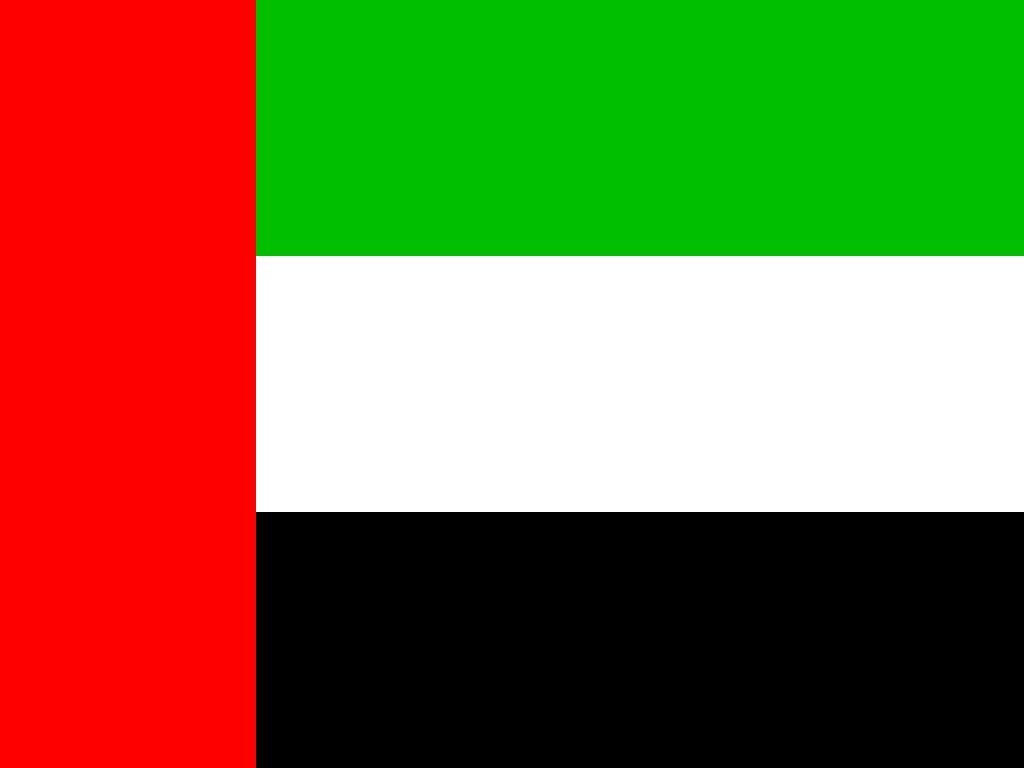
The United Arab Emirates is one of the world's fastest growing tourist and business destinations. Traditional Arab hospitality and comfortable winter temperatures are complemented by sophisticated infrastructure and world-class amenities.
The UAE also has become a world-class venue for conferences, regional and international exhibitions and major global sports events such as the Dubai World Cup for horse-racing, the Abu Dhabi Formula One Grand Prix, the Dubai Desert Classic Golf Tournament, and the Fifa Club World Cup, to be held in Abu Dhabi in 2009 and 2010.
The United Kingdom's largest online travel agent, expedia.co.uk, selected Abu Dhabi as one of the world's top 10 travel destinations in 2008. And Dubai International Airport won the award for the Middle East's leading airport in the 2007 World Travel Awards.
There is much to do in the UAE beyond Dubai and Abu Dhabi. First settled during the Bronze Age, Sharjah is the cultural capital of the emirates. The Heritage Area of Sharjah City includes a Maritime Museum, an Islamic Museum and museums for traditional and contemporary Arabic art, among many others.
Ajman attracts international visitors with beautiful beaches, as does Fujairah which also offers snorkeling and diving and excursions to the Musandam Peninsula, renowned for the unspoiled nature of its sheer cliffs, rocky coves and coral reefs
Ra's al Khaymah, on the border with Oman, is probably best known among local adventure travelers for the rugged Hajar Mountains.
History
The UAE’s rich history is rooted in trade and tied to Islam, which came to the region in AD 630. Its location between Europe and the Far East attracted merchants from India and China and was prized by Europeans, in particular the Portuguese, the Dutch and the British.
While Europeans sought control of the coasts, inland, the ancestors of the Bedouin made the sandy deserts of Abu Dhabi and Dubai their home. The town of Abu Dhabi became an important center.
In the 19th century, the British signed a series of agreements with the individual emirates that resulted in the area becoming known as “The Trucial States.” They agreed not to dispose of any territory except to the United Kingdom and not to enter into relationships with any foreign government other than the United Kingdom without its consent. In return, the British promised to protect the coast from all aggression by sea and to help in case of land attack.
The pearling industry thrived in 19th and early 20th centuries, providing income and employment to the people of the Gulf. Many inhabitants were semi-nomadic, pearling in the summer and tending date gardens in the winter. But the economic depression in the late 1920s and early 1930s, coupled with the Japanese invention of the cultured pearl, irreparably damaged the industry.
New Beginnings
In the early 1930s the first oil company teams conducted geological surveys. In 1962, the first cargo of crude was exported from Abu Dhabi. With oil revenues growing year by year, HH Sheikh Zayed bin Sultan Al Nahyan was chosen as Ruler of Abu Dhabi in 1966. He undertook a massive program of construction of schools, housing, hospitals and roads.
One of Sheikh Zayed’s early steps was to increase contributions to the Trucial States Development Fund. Abu Dhabi soon became its largest donor. In the meantime, HH Sheikh Rashid bin Saeed Al Maktoum, de facto Ruler of Dubai since 1939, developed shipping to replace pearling revenues. When Dubai’s oil exports started in 1969, Sheikh Rashid was able to use oil revenues to improve the quality of life of his people.
At the beginning of 1968, when the British announced their intention to withdraw from the Arabian Gulf, Sheikh Zayed acted rapidly to establish closer ties with the emirates. With Sheikh Rashid, Sheikh Zayed called for a federation that would include not only the seven Emirates that together made up the Trucial States, but also Qatar and Bahrain.
Agreement was reached between the rulers of six of the Emirates (Abu Dhabi, Dubai, Sharjah, Umm al-Qaiwain, Fujairah and Ajman), and the Federation to be known as the United Arab Emirates was formally established on 2 December 1971. The seventh Emirate, Ra’s al-Khaimah, acceded to the new Federation the following year.
Since then, the seven Emirates have forged a distinct national identity. The UAE’s political system combines traditional and modern and enabled the country to develop a modern administrative structure while ensuring that traditions of the past are maintained, adapted and preserved.
Government
Under the UAE system of government, the President of the Federation is elected by a body known as the Supreme Council of Rulers. The Supreme Council is the top policy-making body in the UAE, and the President and Vice President are both elected from its membership for renewable five-year terms.
The Supreme Council has both legislative and executive powers. In addition to planning and ratifying federal laws, the Supreme Council approves the President’s nominated Prime Minister and is equipped to accept his resignation, if required.
The Prime Minister is appointed by the President. He or she then appoints a Council of Ministers, or Cabinet, to oversee the development and implementation of federal policy across all portfolios of government.
In addition to the Supreme Council and the Council of Ministers, a 40-member parliament known as the Federal National Council (FNC) also examines proposed new legislation and provides advice to the UAE Cabinet, as required. The FNC is empowered to call and question Ministers in regard to their own performance, providing an additional degree of accountability to the system. Groundbreaking developments to open up decisionmaking were made in December 2006, with the first indirect election of FNC members. Previously, all FNC members were appointed by the Rulers of each Emirate.
The introduction of indirect elections represents the beginning of a process to modernize the UAE’s system of government. Under these reforms, individual Rulers select an electoral college whose members total 100 times the number of FNC members held by that Emirate. The members of each college then elect half of the FNC members, while the other half continue to be appointed by each Ruler.
The process resulted in an FNC in which one-fifth of its members are women.
Future initiatives are expected to expand the size of the FNC and strengthen the interaction between it and the Council of Ministers, to further improve the efficiency, accountability and participatory nature of government in the UAE. In November 2008, the terms for FNC members were extended from two to four years, which is more consistent with other parliaments in the world. In addition, the government will report to the FNC about proposed international treaties and agreements, and those agreements will be discussed by the FNC before their ratification.
Historically, the political environment of the UAE has been characterized by great affection for the country’s leadership and institutions of government. This is largely in response to the rapid growth and development the UAE has experienced under their guidance in recent decades.
RUSSIA
Russia is the largest country in the world, located in Eastern Europe and north part of Asia.
Population
According to the data provided by the Federal Service of the State Statistics of the Russian Federation, the population of Russia as of September 1, 2009 was 141.9 million people. The majority of the population is concentrated in the European part of the country. 73.3% of the population lives in urban areas, 26.7% - in rural areas. Russia is a multiethnic state. Over 180 nationalities live in Russia, the largest (80% of the population) being Russians. Russian is the official state language. Orthodox Christianity is the dominant religion. Islamic, Catholic, Buddhist and other confessions exist.
State
Russia is a democratic federal state with a republic type of government. The legislative body of the Russian Federation is the two-chamber Federal Assembly (Council of the Federation and the State Duma). The Council of the Federation consists of representatives of each federal entity. The Deputies of the State Duma are elected from party lists on the basis of the proportion of the nationwide votes that each party gets for a term of 5 years.
The Head of State is the President of the Russian Federation, also being the Supreme Commander-in-Chief of the Armed Forces. Citizens of Russia elect the President for a term of 6 years by direct secret ballot vote.
The executive branch is represented by the Government of the Russian Federation. The Chairman of the Government is appointed by the President with the consent of the State Duma. The Russian Federation consists of 83 federal entities (republics, territories and regions), including cities of Moscow and St.Petersburg. Moscow is the capital of Russia.
Territory and climate
The total area of Russia is 6,592,848 sq. miles (17,075,400 sq. km). Over 45% of the country’s area is covered by forests, 4% - by water, 13% - arable land, 19% - deer grazing land, 19% - other.
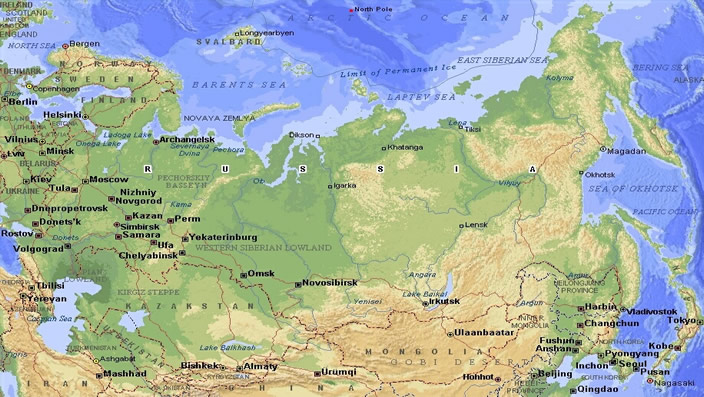
A large part of the European territory of the country is situated on the East European plain; in the south it is limited by the northern slopes of the Caucasus Mountains and has the Khibin Mountains to the Northwest. To the East of the Ural mountains lies the West Siberian plain surrounded by the mountains of South Siberia (Altay, Sayanas, Baikal mountains, etc.). Between the Yenisey and Lena rivers lies the Midsiberian plateau and further East, between the Lena and the Pacific coast spread the mountains and plateaus of North-East Asia.
Russia has about 2.5 million rivers and 2 million fresh and salt water lakes. The largest rivers are Volga, North Dvina, Don, Pechora, Ob, Yrtysh, Yenisey, Angara, Lena, Amur; the largest lakes are the Caspian (Sea), Baikal, Ladoga, Onega. Russia has 35 national parks and 84 natural reserves.
The climate changes from marine in the extreme Northwest to harsh continental in Siberia and monsoon in the Far East. Russia has the following climatic zones: arctic desert, tundra, forest tundra, forest, forest steppe, steppe, semidesert. Average temperatures in January are from 32 F to -58 F (0° C to -50° C), in July – from 33.8 F to 77 F (+1° to +25° C); precipitation is from 5.9” to 78.8” (150 to 2000 mm) per year. Parts of Siberia and Far East are covered by permafrost.
Land borders exist with the following countries: Abkhazia 152 miles, Azerbaijan 203 miles, Belarus 770 miles, China 2615 miles, Estonia 202 miles, Finland 790 miles, Georgia 346 miles, Kazakhstan 4668 miles, Latvia 168 miles, Lithuania 165 miles, Mongolia 2165 miles, North Korea 10,5 miles, Norway 122 miles, Poland 127 miles, South Ossetia 46 miles, Ukraine 1197 miles.
The country has 12 economic zones (based on regional economic specialization): Northern, Northwestern, Central, Central-Black Earth, North Caucasus, Volga-Vyatka, Volga, Urals, East Siberia, West Siberia, Far East, Kaliningrad.
Culture, Traditions, and History
"Water is a Turkmen's life, a horse is his wings, and a carpet is his soul"
The energy-rich Central Asian country revives its most ancient rituals and customs and discovers old taboos that were thinly papered over during Communist rule.

Yurta, the traditional tent (it has a collapsable wooden frame and is covered with reeds and felt) is still used today. The tent is placed in the front yard and used as a summer house...
National dress: men wear high, shaggy sheepskin hats and red robes over white shirts. Women wear long sack-dresses over narrow trousers (the pants are trimmed with a band of embroidery at the ankle). Female headdresses usually consist of silver jewelry. Bracelets and brooches are set with semi-precious stones. Young women with two braids and a small scarf are unmarried; those with one braid and a big kerchief have been wed.
History of Turkmenistan
Tools from the Stone-Age have been discovered along the Caspian Sea shore and near the modern port of Turkmenbashi, establishing the pre-historic presence of humans in the area that is today known as Turkmenistan. The remains of farming settlements in the Kopet-Dag Mountains date back 8,000 years. The ancient cultivators in this region used the mountain streams to irrigate their crops. They also survived by herding livestock and by hunting wild game.
As early societies learned to make pottery and metal tools, they began to trade with other people of central Asia. This profitable trade, however, also attracted foreign invaders. By the 6th century B.C., the powerful Persian Empire had established the provinces of Parthia and Margiana in what is now Turkmenistan. From their base south of the Kopet-Dag range the Persians controlled trade through central Asia and subdued the many nomadic people who lived on Turkmenistan's arid plains.
Early Rulers
In the 4th century B.C., the Persian Empire was defeated by the army of Alexander the Great. In 330 B.C., Alexander marched northward into Central Asia and founded the city of Alexandria near the Murgab River.
Located on an important trade route, Alexandria later became the city of Merv (modern Mary). The ruins of Alexander's ancient city are still visible along the banks of the Murgab River.
After Alexander's death in 323 B.C., his generals fought for control of his empire, which quickly fell apart. The Scythians—fierce, nomadic warriors from the north—then established the kingdom of Parthia, which covered present-day Turkmenistan and Iran. The Parthian kings ruled their domain from the ancient city of Nisa. At its height, Parthia extended south and west as far as the Indus River in modern India.
Parthia fell in A.D. 224 to the Sasanian rulers of Persia. At the same time, several groups—including the Alans and the Huns—were moving into Turkmenistan from the east and north. A branch of the Huns wrested control of southern Turkmenistan from the Sasanian Empire in the 5th century A.D.
The Arrival of the Oguz
Although Turkmenistan was still populated mostly by nomadic herders, permanent settlements were prospering in the fertile river valleys. Farmers raised grains, vegetables, and fruits along the Amu Darya River; and Merv and Nisa became centers of sericulture (the raising of silkworms). A busy caravan route, connecting China and the city of Baghdad (in modern Iraq), passed through Merv. In addition, merchants, traders, and missionaries introduced the religions of Buddhism and Zoroastrianism to the region.
Central Asia came under Arab control after a series of invasions in the late 7th and early 8th centuries. Meanwhile, the Oguz—the ancestors of the Turkmen—were migrating from eastern Asia into central Asia, the Middle East, and Asia Minor (modern Turkey). The Arab conquest brought the Islamic religion to the Oguz and to the other people of central Asia.
By the 11th century, the Oguz were pushing to the south and west, and the Arabs were retreating from Turkmenistan. In 1040, the Seljuk clan of the Oguz tribe established the Seljuk Empire, with its capital at Merv. At one time, the Seljuk realm stretched all the way to Baghdad. Other Oguz groups moved west across the Caspian Sea, settling in Azerbaijan and in Asia Minor, where they joined the Seljuk Turks in establishing the Ottoman Empire. After mixing with the settled people in Turkmenistan, the Oguz living north of the Kopet-Dag Mountains gradually became known as the Turkmen.
In the 11th and 12th centuries, the main centers of Turkmen culture were at Khiva in the north (now in Uzbekistan) and at Merv in the south. Khiva controlled the cities and farming estates of the lower Amu Darya Valley. Merv became a crossroads of trade in silk and spices between Asia and the Middle East. This business created vast wealth in the ancient city, where the Seljuk rulers built fabulous mosques and palaces. At the same time, a growing class of wealthy traders and landowners was challenging the Seljuks for control of Turkmenistan.
Mongol Invasions
In 1157, during a revolt of powerful landowners, the Seljuk Empire collapsed. The leaders of Khiva took control of Turkmenistan, but their reign was brief. In 1221, central Asia suffered a disastrous invasion by Mongol warriors who were sweeping across the region from their base in eastern Asia.
Under their commander Genghis Khan, the Mongols conquered Khiva and burned the city of Merv to the ground. The Mongol leader ordered the massacre of Merv's inhabitants as well as the destruction of Turkmenistan's farms and irrigation works. The Turkmen who survived the invasion retreated northward to the plains of Kazakhstan or eastward to the shores of the Caspian Sea.
After Genghis Khan's death in 1227, the Mongols lost control of Turkmenistan. Small, semi-independent states arose under the rule of the region's landowners. In the 1370’s, the Mongol leader Timur (known as Tamerlane in Europe), a descendant of Genghis Khan, conquered these states once more and established the Timurid Empire. But after Timur's death in 1405, the realm weakened and soon disintegrated.
The Mongol invasions had divided the Turkmen into small clans and had pushed them into the desert. Later, as the Mongols retreated from Turkmenistan, the Turkmen fell under the control of Muslim khans (rulers) who established khanates in Bukhara (in modern Uzbekistan) and Khiva.
The rivalry between the khans and the rulers of Persia touched off centuries of war in Turkmenistan. Persians, Turkmen, and the khans fought for the scattered oases in southern Turkmenistan. From the 14th through the 17th century, Turkmenistan was in decline. To escape the conflicts, most Turkmen moved to the remote deserts along the borders of Persia and Afghanistan.
Russia and Turkmenistan
In the 18th century, after centuries of poverty and isolation, the Turkmen began to rebuild their way of life. The poet Magtymguly created a literary language for the Turkmen and laid the foundations for their modern culture and traditions. Keimir-Ker, a Turkmen from the Tekke clan, led a rebellion of the Turkmen against the Persians, who were occupying most of Turkmenistan. Popular ballads and folk legends still recount the deeds of Keimir-Ker.
At this time, the Russian Empire was expanding into central Asia from the plains and forests of eastern Europe. The Russian czar, Peter the Great, sent the first Russian expeditions into Turkmenistan. Peter was seeking a route for Russian trade with southern Asia and the Middle East. In 1716, however, members of a Turkmen clan murdered the czar's representatives near Khiva. Russia waited for more than a century before sending another mission into Turkmenistan.
Nevertheless, trade between Turkmen merchants and Russia continued and was helped by the building of a port on the Caspian Sea at Krasnovodsk, (modern Turkmenbashi). In 1802, members of several Turkmen clans officially became Russian subjects. During the 19th century, the Turkmen also asked for Russia's help during their frequent rebellions against the khans and against the shahs of Persia. The Russians were seeking new markets for their goods, fertile land for the growing of cotton, and access to Turkmenistan's natural resources. As a first step in the conquest of the region, the Russians agreed to provide arms and food to the Turkmen rebels.
Russia began sending military expeditions into Turkmenistan in the second half of the 19th century. From 1863 through 1868, Russian armies defeated and annexed the khanates of Bukhara and Khiva. The people of western Turkmenistan, who were seeking independence from the khans, willingly joined the Russian Empire.
But the Turkmen of eastern and southern Turkmenistan fiercely resisted Russian annexation. In 1879, at Geok-Tepe near Ashkhabad (modern Ashgabat) Turkmen warriors of the Tekke den stopped a large Russian force. Two years later, the Russians besieged Geok-Tepe, eventually capturing it as well as Ashkhabad.
By 1885, all of the Turkmen clans had submitted to Russian control. The Russians annexed Mary and pushed across Turkmenistan to the borders of Persia and Afghanistan. The building of the Transcaspian Railroad, which connected Krasnovodsk (modern Turkmenbashi), Mary, and trading centers to the east, opened up the region for economic development.
From 1890 to 1917, Turkmenistan was part of Russian Turkestan, a province that included central Asia and its Muslim nationalities—the Kazakhs, the Uzbeks, the Kyrgyz, the Taliks, and the Turkmen. Within Turkestan, however, the Turkmen had a lesser status. Their lands were defined as the Transcaspian Region and were ruled as a military colony. This neglect by Russia's government allowed the Turkmen to maintain their culture, language, and nomadic way of life.
War and Revolution
In the early 20th century, discontent with strict czarist rule spread among the people of the Russian Empire. At the same time, the empire was being drawn into a bloody international conflict. During World War I (1914-1918), the Turkmen and other people of central Asia moved to reclaim their homelands. A violent uprising broke out in 1916, when the Turkmen, led by Dzhunaid Khan, defeated the Russians at Khiva. The Turkmen established a national government that lasted until 1918.
In October 1917, the Communist leader Vladimir Ilich Lenin overthrew the Russian government. The Communists succeeded in taking control of Ashkhabad in the summer of 1918. In response, Dzhunaid Khan and forces loyal to the old Russian regime joined together to drive out the Communists. In July of 1919, these anti-Communist allies established the independent state of Transcaspia.
Soviet Victory and Stalin's Rule
By the fall of 1920, however, the Communist Red Army was advancing from Tashkent (in modern Uzbekistan) and from Bukhara. The Communists gradually subdued Turkmenistan by military occupation and by putting Communist politicians in control of local governments. In 1922, the Communists founded the Union of Soviet Socialist Republics (USSR). Two years later, they established the Turkmen Soviet Socialist Republic (SSR) as a full member of the USSR.
In the late 1920s and early 1930s, the Soviet leader Joseph Stalin made harsh and sweeping changes throughout the USSR. Private property was seized, and the Soviet government used brutal methods to punish opposition. These policies sparked a rebellion in Turkmenistan, and in 1927 the Soviets lost control of the republic to a national resistance movement called the Turkmen Freedom.
After reclaiming the Turkmen SSR in 1932, Stalin executed thousands of Turkmenistan's Communist leaders—including the president and the premier—whom he accused of helping the nationalists. After the terror of the 1930s, the Communist regime in Ashkhabad became completely obedient to the central Soviet government in Moscow.
Meanwhile, another international conflict was brewing in Europe. The western Soviet Union was devastated by World War II (1939-1945), when Germany invaded with a huge military force. Fierce fighting destroyed factories, farms, and cities throughout western Russia and Ukraine. After the war, the Soviets built new plants in central Asian cities, including Ashkhabad and Chardzhou (modern Turkmenabat). A work force made up of ethnic Russians and ethnic Ukrainians emigrated to the Turkmen SSR to take advantage of new jobs in the republic.
Most Turkmen, however, remained rural and nomadic. Despite the immigration of factory workers, the Turkmen SSR remained one of the Soviet Union's most isolated republics. Foreigners, and even Soviet citizens, were forbidden to visit most of the region, and the Soviet government also would not allow most Turkmen to travel out side the republic.
In spite of the republic's isolation, economic development continued in the region. New irrigation projects diverted water from rivers to collective farms, many of which began growing fruits and vegetables instead of cotton. During the 1970s, the Soviet government also developed the region's energy resources, including oil and natural gas.
The Soviet leader Mikhail Gorbachev instituted several new policies after coming to power in 1985. Glasnost allowed more open criticism of the Communist party and of the country's economic system. Perestroika eased government control over many small businesses, which could now set their own wages, prices, and production schedules. Turkmen Communist leaders, however, were slow to adopt these reforms. Annamurad Khodzhamuradov, who became the Turkmen SSR's leader in 1986, remained loyal to the Soviet government but never accepted Gorbachev's reforms.
Independence
In the late 1980s, many Soviet republics attempted to gain their independence from Moscow. In 1990, the Turkmen SSR declared that it would take greater control over local politics and economic policy. The government established the office of president and named Saparmurat Niyazov to the post.
On October 27, 1991 Turkmenistan proclaimed its independence from the USSR.
Kazakhstan’s geographical and geopolitical position has played a vital role in promoting the country’s development. Located in the center of Eurasia, Kazakhstan has found itself at the crossroads of the world’s most ancient civilizations and trade routes. It has been a land of social, economic, and cultural exchange between East and West, North and South, and major Eurasian nations. At different stages of its history, various states emerged, developed, and contributed to the land that became today’s Kazakhstan.
A thousand years before the Christian era, the nomadic Skythian-Saka civilization prospered on the Central Asian steppes. Many of their cultural monuments have survived, including impressive tools and everyday items made in gold and bronze, extracted from ancient burial mounds. Another worthy extraction, the royal tomb of the Golden Warrior Prince of the Saka civilization, was found in the ancient town of Issyk and is famous for its integrity, beauty, elegance, and craftsmanship. This cultural treasure’s motifs have become the basis of the modern Monument of Independence, erected in Almaty in the early 1990s.
In later centuries, the steppes were home to a powerful state formed by the Huns, whose empire greatly influenced the geopolitical map of that time. In fact, the Great Roman Empire was eventually destroyed by the blows of Attila the Hun’s daring warriors.
Later, the Huns were replaced by Turkic tribes who founded several large states known as kaganats, stretching from the Yellow Sea in the East to the Black Sea in the West. These states were distinguished by a progressive culture, not only based on a nomadic economy but also on an oasis urban culture with rich trade and handicraft traditions. During this time, cities and caravanserais (roadside inns) were founded in the oases of Central Asia, the territory of South Kazakhstan, and Central Asia, and stood along the famous trade route known as the Great Silk Road which connected Europe and China. The route along the Syr Dariya River to the Aral Sea and the South Urals, as well the Sable Road from South Western regions of Siberia through Central Kazakhstan and the Altai region, were also very important. It was through trade on the Sable Road that the Middle East and Europe were supplied with expensive furs. Major cities and trade centers founded on these routes included:
- Otrar (Farab)
- Taraz
- Kulan
- Yassy (Turkestan)
- Sauran
- Balasagun
 The Great Silk Road not only stimulated the development of trade, it also became a conduit for new scientific and cultural ideas. For example, the great philosopher Al-Farabi (870-950) was largely influenced by the culture of the trade routes. Born in the Farab district, Al-Farabi was dubbed “the Second Teacher,” after Aristotle, for his profound findings in the following fields:
- Philosophy
- Astronomy
- Musical theory
- Mathematics
In the 11th century, the outstanding scholar of Turkic philology, Mahmud Kashgari, created the three-volume Dictionary of Turkic Dialects, dedicated to Turkic folklore and literature heritages. Around the same time, Yusup Balasaguni, a famous poet and philosopher from Balasagun, wrote Kutaglu Bilig (A Knowledge that Brings Happiness) which is thought to have played an important role in the development of many modern conceptions, including:
- Sociology
- Politics
- Ethics
Part of the cultural legacy of that period is the elegant urban architecture. Some of the best preserved examples are the mausoleums of:
- Arystan Baba
- Sufi Hodja Akhmet Yassaui in Turkestan
- Aisha Bibi in Taraz.
Apart from this, the most ancient nomads of the region invented the yurt, a dome-shaped portable house made from wood and felt, ideal for an itinerant life.
Years later, in 1221, Mongolian tribes of Genghis Khan conquered Central Asia and added their own culture and values to the increasingly complex society of the region.
By the second half of the 15th century a process of consolidation had begun among the peoples of the Central Asian steppe. Derived from the various ethnic and cultural identities, this process was drawn together by a common world view and lifestyle. The first Kazakh khanates emerged at this time, and by the first half of the 16th century, the formation of a single Kazakh nation was completed. The word “Kazakh” in the old Turkic language meant “free” or “independent,” perfectly defining the people who had been yearning for their own independent state.
In the 17th and 18th centuries, the nomadic Jungar tribes, directed by the Chinese Bogdykhans, started a large scale war against the Kazakh khanate. Fortunately, the people escaped total capture and physical annihilation, due to a variety of factors:
- The courage of the “batyrs” (knights)
- The decisiveness of the Kazakh leader, Ablai Khan
- The diplomatic skills of the Kazakh ‘biys’ (sages), Tole Bi, Kazdausty Kazybek Bi, and Aiteke Bi
- The self sacrifice of the people.
The Kazakhs were never able to fully recover from the war or establish themselves as a powerful military force; therefore, they sought the protection of the Russian Empire and lost sovereignty in 1871. For a time, the fate of Kazakhstan was tied to that of the Russian State and its peoples, as well as the European model of social development.
After the 1917 revolution, Soviet power was established in Kazakhstan, and the people suffered greatly. Due to the forced collectivization in the 1930s, hunger caused the death of 1.5 million Kazakhs, more than 40 percent of the nation. Many of those who survived fled to China, while others, mostly gifted intellectuals, were repressed and often killed by the Soviet regime. In protest, Kazakhs took to the streets on December 17, 1986, indicating to the world that the reign of the once powerful Soviet Union was soon coming to an end.
Five years later, Kazakhstan proclaimed its independence on December 16, 1991, and Nursultan Nazarbayev was democratically elected the first President of the country.
Ethnic Composition
As of 2006, the ethnic composition of Kazakahstan is comprised of:
- Kazakh, 59.2 percent
- Russian, 25.6 percent
- Ukrainian, 2.9 percent
- Uzbek, 2.9 percent
- Uyghur, 1.5 percent
- Tatar, 1.5 percent
- German 1.4 percent
Ethnic Movement
In 1991, the Kazakh and Russian populations were generally equal. However, between 1989 and 1999 approximately 1.5 million Russians and 500,000 Germans (more than half the German population) left Kazakhstan. This disconcerting mass exodus led to concern over the loss of the technical expertise provided by these ethnic groups. Unfortunately, these trends have continued, evidenced by Germans falling from almost six percent in 1989 to a current 1.5 percent and Russians now forming only a quarter of the current overall population.
Clearly, Kazakhstan is one of the rare countries in which the national ethnicity has not always been the majority. In 1994, eight of the country's eleven provinces had Slavic population majorities, leaving only three provinces with a Kazakh majority. In fact, even the former capital, Almaty, had a European majority. Overall, the 1994 population consisted of the following groups:
* Kazakh, 44 percent
* Russian, 36 percent
* Ukrainian, 5 percent
* German, 4 percent
* Tatars and Uzbeks, 2 percent each
* Azerbaijanis, Uygurs, and Belarusians, 1 percent each
* Ninety other nationalities, 4 percent.
Kazakhstan's ethnic composition is the driving force behind much of the country's political and cultural life. Though the Republic has a variety of ethnicities, the majority can be broken down into two main groups, the Kazakhs and the "Russian-speakers"(Russians, Ukrainians, Germans, and Belarusians). To the Russians, mostly living in northern Kazakhstan, it is an extension of the Siberian frontier and a product of Russian and Soviet development. Roughly 38 percent of Kazakhstan’s Russian population was born outside the Republic, while most of the remaining majority are second-generation Kazakhstan citizens. In addition, further Russian movement occurred when the capital city of Almaty was moved to Astana; the Kazakh population moved northward and Russian-dominated northern provinces were absorbed into the Kazakhstan state.
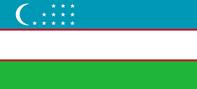
Official Name: Republic of Uzbekistan.
Capital: Tashkent.
National Holiday: September 1St 1991, Independence Day from Russia
Government type: Republic.
Administrative Division: 12 provinces.
President: Islam Karimov.
Location: Central Asia
Territory Size: 447, 400 Square Kilometers
Border Countries: Uzbekistan shares borders with Afghanistan, Kazakhstan, Kyrgyzstan, Tajikistan and Turkmenistan.
Population: 27,606,007 habitants (July 2009 est.)
Ethnic Group(s): Uzbek 80%, Russian 5.5%, Tajik 5%, Kazakh 3%, Karakalpak 2.5%, Tatar 1.5%, other 2.5%
Religion(s): Muslim 88% (mostly Sunnis), Eastern Orthodox 9%, other 3%
Language(s): Uzbek 74.3%, Russian 14.2%, Tajik 4.4%, and other 7.1%
Economy 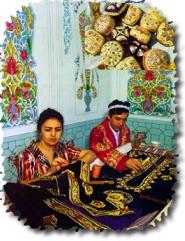
Natural Resources: natural gas, petroleum, coal, gold, uranium, silver, copper, lead and zinc, tungsten, molybdenum, among others.
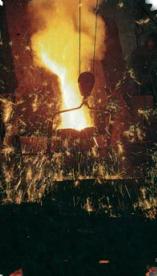
Industry: textiles, food processing, machine building, metallurgy, gold, petroleum, natural gas, and chemicals
Agriculture: cotton, vegetables, fruits, grain; livestock
Oil Production: 83,820 Barrels a day.
Oil Exports: 6,104 Barrels a day.
Natural Gas Production: 67.6 billion cubic meters.
Natural Gas Exports: 15 billion cubic meters.
Know a Little bit about Uzbekistan
This land was conquered by Russia in the 19th Century. During the Bolshevik revolution, they gather a resistance, but it was suppressed and the red army established a social republic in 1924. The soviets used their territory to the intensive production of cotton and grain, which led to intensive use of agrochemicals and left a serious poisoning land issue and depletion of water.
Since independence, the governments has applied polices to develop the mineral and petroleum reserves to change their agricultural economy. Nevertheless, their concerns also includes terrorism by Islamic militants, economic stagnation, and the curtailment of human rights and democratization.

Culture and Traditions
Culture of Uzbekistan is one of the brightest and original cultures of East. It is inimitable national music, dances and painting, unique national kitchen and clothes. The Uzbek national music is characterized as variety of subjects and genres. The songs and tool plays according to their functions and forms of usage can be divided into two groups: performed in the certain time and under the certain circumstances and performed at any time. The songs connected with customs and traditions, labor processes, various ceremonies, dramatized entertainment representations and games belong to the first group.
 The Uzbek people is well-known for its songs. Koshuk - household song with a small diapason melody, covering one or two rows of the poetic text. The dancing character of a melody of this genre provides their performance in support of comic dances. "Lapar" is a dialogue-song. In some areas the term - lapar is applied to wedding songs "Ulan" (which is performed as a dialogue of man and women). Genre "yalla" includes two kinds of songs: a melody of a narrow range, and solo simultaneously with dance. National and professional poems of the poets of East are used as the texts for the songs. The special place in the Uzbek musical heritage occupy "dastans" (epic legends with lyric-heroic content). Also "Makoms"- are the basic classical fund of professional music of oral tradition.
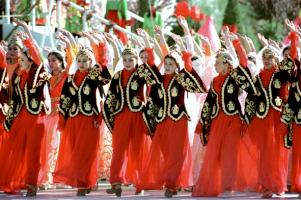
The dances of uzbeks distinguish softness, smoothness and expressiveness of movements, easy sliding step, original movements on a place and on a circle.
The development of national painting began many centuries ago. At 16-17 centuries art of the manuscript and binding in Bukhara and some other urban centers has achieved significant success. The decorating of manuscript included refined calligraphy, performance by water paints and thin ornaments on fields. In Samarkand and especially in Bukhara the Central Asian school of a miniature has achieved a great success and were developed many different style directions. One of them, for example is connected with traditions of Behzod, which characterized with its gentle style of writing the letter and architectural elements.
Applied art of Uzbeks has a wealth of variety when it comes to style, materials and ornamentation. Silk, ceramics and cotton weaving, stone and wood carving, metal engraving, leather stamping, calligraphy and miniature painting are some genres passed down from ancient times. Back in the past, each region had its own cultural and ethnic traditions the unique features of which were established by local guilds that have strengthened these characteristics through their art.
 Uzbek craftsmen nowadays still practice ancient jewellery making techniques for cutting gemstones, grain filigree, granular work, engraving and enamelling, also they are trying to take into account fashion demands and styles.
Embroidery is one of the most popular trends of applied arts in Uzbekistan. Every city of Uzbekistan has its own unique features such as ornamentation, composition, colour range and stitching. The finest kind of embroidery, gold embroidery is still practised in Bukhara.
The art of carpet weaving is also a very ancient form of art throughout Asia and the East, and nowadays it can be found in some of the cities of Uzbekistan today. The art of wood carving is used and adapted in modern interior design. Carved and painted tables, stools, caskets, pencil boxes and bookstands are popular pieces of furniture among local people and tourists. The art of Miniature painting and calligraphy has been revived again in its traditional form as well as some modern variants. For example miniatures stamped on leather, painted on paper miniatures, small lacquered boxes, framed pictures, pencil boxes and many other ideas skilfully painted by masters can be found in Uzbekistan.
The Uzbek people is well-known for its songs. Koshuk - household song with a small diapason melody, covering one or two rows of the poetic text. The dancing character of a melody of this genre provides their performance in support of comic dances. "Lapar" is a dialogue-song. In some areas the term - lapar is applied to wedding songs "Ulan" (which is performed as a dialogue of man and women). Genre "yalla" includes two kinds of songs: a melody of a narrow range, and solo simultaneously with dance. National and professional poems of the poets of East are used as the texts for the songs. The special place in the Uzbek musical heritage occupy "dastans" (epic legends with lyric-heroic content). Also "Makoms"- are the basic classical fund of professional music of oral tradition.The dances of uzbeks distinguish softness, smoothness and expressiveness of movements, easy sliding step, original movements on a place and on a circle.
The development of national painting began many centuries ago. At 16-17 centuries art of the manuscript and binding in Bukhara and some other urban centers has achieved significant success. The decorating of manuscript included refined calligraphy, performance by water paints and thin ornaments on fields. In Samarkand and especially in Bukhara the Central Asian school of a miniature has achieved a great success and were developed many different style directions. One of them, for example is connected with traditions of Behzod, which characterized with its gentle style of writing the letter and architectural elements.
National clothes
The Uzbek national clothes of the end of XX centuries remain constant up these days. The men in that time carried a direct cover shirts, bottom and top dressing gowns. The dressing gowns were very light and made from cotton wool. There were cuts on each side of dressing gown for convenience at walking. The trousers were made wide, of direct breed lent from top to bottom. Female clothes: dressing gowns, dress, "parandja"- also of wide breed.Handicrafts
Culture, handicrafts and tourism are rapidly becoming inseparable partners. Local crafts are important elements of culture, and people travel to see and experience other cultures, traditions and ways of living. Crafts products form an important element of the purchases made by tourists, providing an important economic input to the local economy.Applied art of Uzbeks has a wealth of variety when it comes to style, materials and ornamentation. Silk, ceramics and cotton weaving, stone and wood carving, metal engraving, leather stamping, calligraphy and miniature painting are some genres passed down from ancient times. Back in the past, each region had its own cultural and ethnic traditions the unique features of which were established by local guilds that have strengthened these characteristics through their art.
Uzbek craftsmen nowadays still practice ancient jewellery making techniques for cutting gemstones, grain filigree, granular work, engraving and enamelling, also they are trying to take into account fashion demands and styles.Embroidery is one of the most popular trends of applied arts in Uzbekistan. Every city of Uzbekistan has its own unique features such as ornamentation, composition, colour range and stitching. The finest kind of embroidery, gold embroidery is still practised in Bukhara.
The art of carpet weaving is also a very ancient form of art throughout Asia and the East, and nowadays it can be found in some of the cities of Uzbekistan today. The art of wood carving is used and adapted in modern interior design. Carved and painted tables, stools, caskets, pencil boxes and bookstands are popular pieces of furniture among local people and tourists. The art of Miniature painting and calligraphy has been revived again in its traditional form as well as some modern variants. For example miniatures stamped on leather, painted on paper miniatures, small lacquered boxes, framed pictures, pencil boxes and many other ideas skilfully painted by masters can be found in Uzbekistan.
Culture
Foreign Policy
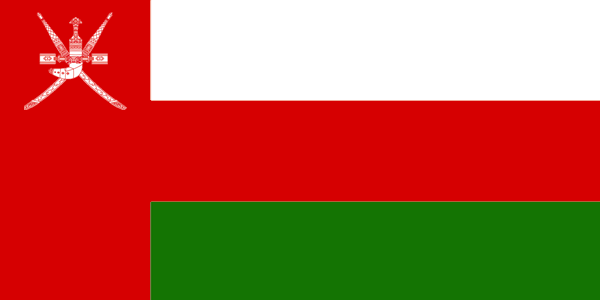
Over the past 37 years the Sultanate's foreign policy has helped strengthen its bilateral links and promote mutual interests with other states, while at the same time serving the cause of national development and the peace, security and stability of this vital region and its people. His Majesty pointed out that Oman's foreign policy over recent decades has proved "its viability and soundness". He added:” We are committed to this path, which is based on support for rights, justice, peace, security, tolerance and love, and which calls for international co-operation in order to consolidate stability, promote development and prosperity, and tackle the causes of tension in international relations by providing just and permanent solutions to serious problems that will reinforce peaceful coexistence between nations and lead to the well-being of mankind as a whole."
This is the vision that has determined Oman's approach to issues and developments in the various Gulf, Arab and international arenas. At the same time, the Sultanate works to develop its bilateral relations and widen its circle of friends around the world, opening up new horizons for the Omani economy and generating further progress and prosperity for its people.
The Economic Dimensions of Foreign Policy
Thanks to the warm relations Oman enjoys with countries around the world and its centuries-long experience of trade and contacts, foreign policy has played a vital role in bolstering development efforts. The Sultanate is also a major contributor to economic co operation in the Gulf, Arab, regional and international arenas.
The Free Trade Agreement (FTA) signed by the Sultanate with the United States of America on 19th January 2006 is designed to help boost bilateral trade and investment. It was approved by the US Senate on 19th September 2006 and signed into law by the President on 26th October 2006. The Sultanate enthusiastically supports the Arab Gulf Co-operation Council (AGCC), the Greater Arab Free Trade Zone and the World Trade Organization (of which it is an active member), and in 2003 it joined the Asian Co-operation Dialogue. It helped set up the Indian Ocean Rim Association for Regional Co-operation and is actively engaged in developing closer bilateral relations with numerous states. This has had a tangible effect not only in attracting greater foreign investment to the Sultanate through the funding of major industrial, tourist and service projects in different parts of the country, but also in boosting trade with various countries around the world, to the benefit of the Sultanate's development process.
Oman's close relations with countries in Asia and Africa go back a long way Trade links, particularly with South and South-East Asia and East and Central Africa, first began with the arrival of Omani trading vessels centuries ago, and these associations have increased steadily over the years.
The Sultanate played a major part in establishing the Indian Ocean Rim Association for Regional Co-operation (IORARC) in 1997 and actively promotes measures to promote economic co-operation between member states, particularly in trade, tourism, the sciences, marine transport and fisheries.
Meanwhile, relations with East and Central Africa also continue to flourish with existing extensive ties strengthening annually, opening up the way for ever closer future relationships.
The Sultanate enjoys diplomatic relations with over 140 countries and is a member of over 105 regional and international organizations.
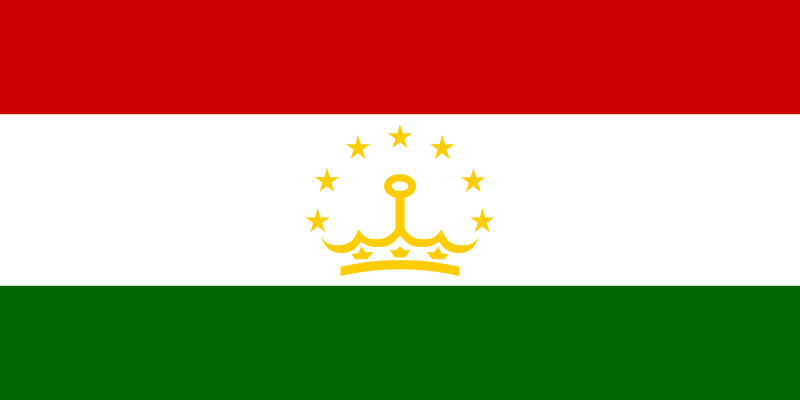
In December 11, 1999, Majlisi Oli (Parliament) of the Republic of Tajikistan approved by its decree the States Symbol of the Republic of Tajikistan.
During the decree, the flag and the emblem of Tajikistan are symbols of state sovereignty.
National Emblem

The National Emblem of the Republic of Tajikistan's represents the image of stylized crown and semicircle from seven stars on it in the beams of sun arising behind of the mountains, covered with snow and framed by wreath which is made on the right from ears of wheat and on the left from branches of a cotton. From above a wreath is interlaced by a three-striped tape and in the bottom sector there is placed a book on the support.
State flag

The state flag of the Republic of Tajikistan represents a right-angled panel consisting from three colored stripes located horizontal: the top stripe - red color and equal to it on width the bottom stripe of green color, the average white stripe, making one and a half width of dense stripes. On a white stripe, at the distance of half of length of a panel from a flagstaff, there is a stylized gold crown and a semicircle from seven stars above it. The attitude of the general width of a flag to length is 1:2. The crown and a star are entered in a rectangle, the sides of which on a vertical make 0,8 and across 1,0 width of a white stripe. Five-pointed stars are entered in a circle with diameter 0,15 and settle down on an arch radius of 0,5 width of a white stripe. There are three colors on a flag of the Republic of Tajikistan: green, red and white. A green stripe are valleys, they are not enough in republic - 7 % of territory. Because the rest of the territory is occupied by mountains. The white stripe is a color of the main richness of republic - cotton and also the color of snow and ice in high mountains. The red color is a color of unification of republic and brotherhood with other nations of the world.
The Kyrgyz Republic
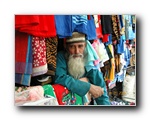
Kyrgyz people represent the title nation of the Kyrgyz Republic, which is one of the most ancient people in the world. The first written evidence of the Kyrgyz people as a nation is found in Chinese chronicles dated as far back as 2,000 BC. They emerged from many ethoses who settled in South Siberia and Central Asia. In the 4-3 centuries BC, the ancient Kyrgyz were part of strong nomadic tribal unions, which proved to be a serious distress to China. It was at this time that construction of the Great Wall of China began.
In the 1-2 centuries BC, a part of the Kyrgyz tribes moved to Enisey (“Ene Sai” translates as “Mother River” from the Kyrgyz language) and Baikal (“Bai Kol” in Kyrgyz means “Abundant Lake”). It was there that the Kyrgyz tribes organized their first state and Kyrgyz Khanate, which began the consolidation of the Kyrgyz nation and formation of its culture. The Kyrgyz written language emerged here, but was lost after the state was dismantled by conquerors. However, the human memory was alive: the outstanding epic "Manas" is a genuine encyclopedia of the Kyrgyz history, society, habits and lifestyle of that time.
It is possible to say that the statehood of Kyrgyzstan was recreated thirteen years ago. Century-long hopes and expectations of the nation have come to reality through the route of sovereign and independent development.
Kyrgyzstan was the first Central Asian country to declare its independence in 1991 and emerge as a democratic and liberal reform-oriented country, providing a comprehensive program of market reforms.
Kyrgyzstan is in the Tien Shan mountain range, which stretches for hundreds of kilometers across the northeastern part of Central Asia. It is located on the same latitude as New York, Italy, Northern Turkey and Japan.
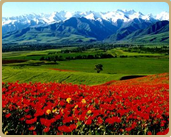
Kyrgyzstan is beautiful, with mountains covering 94 per cent of the country. Their sheer untouched beauty, largely free from ski lifts, funiculars, frequently used paths and observation platforms, stands majestic and intact.
In 1998, the United Nations General Assembly declared the year 2002 as the International Year of Mountains (IYM). During 2002, people all over the world participated in events to celebrate mountains and discuss ways to promote their conservation and sustainable development.
Kyrgyzstan is a remote and mysterious place to many, yet one filled with exotic sights, colorful, pleasant and ruggedly beautiful scenery.
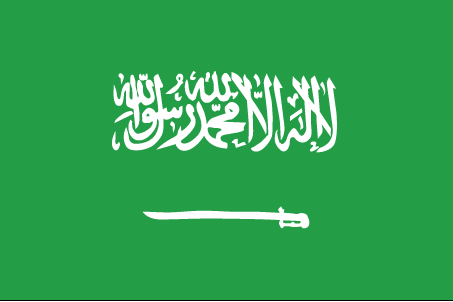
Country Information

The Kingdom of Saudi Arabia is the largest country in the Arabian Peninsula. It occupies an area about the size of the United States east of the Mississippi River. Saudi Arabia’s population is around 22 million (2004 census), and its capital city is Riyadh.
Saudi Arabia’s geography is diverse, with forests, grasslands, mountain ranges and deserts. The climate varies from region to region. Temperatures can reach over 110 degrees Fahrenheit in the desert in the summer, while in the winter temperatures in the north and central parts of the country can drop below freezing. Saudi Arabia gets very little rain, only about four inches a year on average.
Culture & Art
The culture of Saudi Arabia is a rich one that has been shaped by its Islamic heritage, its historical role as an ancient trade center, and its Bedouin traditions.
Saudi society has experienced tremendous development over the past several decades. The Saudi people have taken their values and traditions – their customs, hospitality and even their style of dress – and adapted them to the modern world.
The Crossroads of the World
 Located at the center of important ancient trade routes, the Arabian people were enriched by many different civilizations. As early as 3,000 BC, Arabian merchants were part of a far-reaching trade network that extended to south Asia, the Mediterranean and Egypt. They served as a vital link between India and the Far East on one side, and Byzantium and the Mediterranean lands on the other.
The introduction of Islam in the 7th century AD further defined the region’s culture. Within a century of its birth in the Arabian Peninsula, Islam had spread west to the Atlantic Ocean and east to India and China. It fostered a dynamic period of great learning in culture, science, philosophy and the arts known as the Islamic “Golden Age.”
And every year for the past 14 centuries, Muslim pilgrims from around the world travel to holy sites in Makkah and Madinah, further enriching the region’s culture. The pilgrims brought ivory from Africa and carpets from the East, and took local goods back to their homelands.
When the Kingdom of Saudi Arabia was formed in 1932, King Abdulaziz bin Abdulrahman dedicated himself to preserving Arab traditions and culture, and his sons and successors have done the same.
Arab and Islamic Traditions
Saudi traditions are rooted in Islamic teachings and Arab customs, which Saudis learn about at an early age from their families and in schools.
The highlights of the year are the holy month of Ramadan and the Hajj (pilgrimage) season, and the national holidays that follow them. The holy month of Ramadan, during which Muslims fast from dawn to dusk, culminates with the Eid-Al-Fitr holiday, in which it is customary to buy presents and clothes for children and visit friends and relatives.
The other highlight is the Hajj season, during which millions of Muslim pilgrims from around the world come to Makkah. The Hajj season concludes with the Eid Al-Adha holiday, in which it is traditional for families to slaughter a sheep in memory of Abraham’s willingness to sacrifice his son.
Arab traditions also play an important role in Saudi life. These age-old traditions have evolved over the millennia and are highly regarded. They include generosity and hospitality, which every Saudi family offers to strangers, friends, and family. The simplest expression of hospitality is coffee – its preparation alone is an intricate cultural tradition, and it is often served in small cups along with dates and sweets. Another gesture of hospitality is the burning of incense (oud) to welcome guests.
History
Saudi Arabia traces its roots back to the earliest civilizations of the Arabian Peninsula. Over the centuries, the peninsula has played an important role in history as an ancient trade center and as the birthplace of Islam, one of the world’s major monotheistic religions.

Since King Abdulaziz Al-Saud established the modern Kingdom of Saudi Arabia in 1932, its transformation has been astonishing.
In a few short decades, the Kingdom has turned itself from a desert nation to a modern, sophisticated state and a major player on the international stage.
Early History
The first concrete evidence of human presence in the Arabian Peninsula dates back 15,000 to 20,000 years. Bands of hunter-gatherers roamed the land, living off wild animals and plants.
As the European ice cap melted during the last Ice Age, some 15,000 years ago, the climate in the peninsula became dry. Vast plains once covered with lush grasslands gave way to scrubland and deserts, and wild animals vanished. River systems also disappeared, leaving in their wake the dry river beds (wadis) that are found in the peninsula today.
This climate change forced humans to move into the lush mountain valleys and oases. No longer able to survive as hunter-gatherers, they had to develop another means of survival. As a result, agriculture developed – first in Mesopotamia, then the Nile River Valley, and eventually spreading across the Middle East.
The development of agriculture brought other advances. Pottery allowed farmers to store food. Animals, including goats, cattle, sheep, horses and camels, were domesticated, and people abandoned hunting altogether. These advances made intensive farming possible. In turn, settlements became more permanent, leading to the foundations of what we call civilization – language, writing, political systems, art and architecture.
An Ancient Trade Center
Located between the two great centers of civilization, the Nile River Valley and Mesopotamia, the Arabian Peninsula was the crossroads of the ancient world. Trade was crucial to the area’s development; caravan routes became trade arteries that made life possible in the sparsely populated peninsula.

The people of the peninsula developed a complex network of trade routes to transport agricultural goods highly sought after in Mesopotamia, the Nile Valley and the Mediterranean Basin. These items included almonds from Taif, dates from the many oases, and aromatics such as frankincense and myrrh from the Tihama plain.
Spices were also important trade items. They were shipped across the Arabian Sea from India and then transported by caravan.
The huge caravans traveled from what is now Oman and Yemen, along the great trade routes running through Saudi Arabia’s Asir Province and then through Makkah and Madinah, eventually arriving at the urban centers of the north and west.
The people of the Arabian Peninsula remained largely untouched by the political turmoil in Mesopotamia, the Nile Valley and the eastern Mediterranean. Their goods and services were in great demand regardless of which power was dominant at the moment – Babylon, Egypt, Persia, Greece or Rome. In addition, the peninsula’s great expanse of desert formed a natural barrier that protected it from invasion by powerful neighbors.
The Birth of Islam
Around the year 610, Muhammad, a native of the thriving commercial center of Makkah, received a message from God (in Arabic, Allah) through the Angel Gabriel. As more revelations bid him to proclaim the oneness of God universally, the Prophet Muhammad’s following grew.
In 622, learning of an assassination plot against him, the Prophet led his followers to the town of Yathrib, which was later named Madinat Al-Nabi (City of the Prophet) and now known simply as Madinah. This was the Hijrah, or migration, which marks the beginning of the Islamic calendar.
Within the next few years, several battles took place between the followers of the Prophet Muhammad and the pagans of Makkah. By 628, when Madinah was entirely in the hands of the Muslims, the Prophet had unified the tribes so successfully that he and his followers reentered Makkah without bloodshed.
The Islamic Empire
Less than 100 years after the birth of Islam, the Islamic Empire extended from Spain to parts of India and China. Although the political centers of power had moved out of the Arabian Peninsula, trade flourished in the area.
Also, a large number of pilgrims began regularly visiting the peninsula, with some settling in the two holy cities of Makkah and Madinah. These pilgrims facilitated the exchange of ideas and cultures between the people of the peninsula and other civilizations of the Arab and Muslim worlds.
The emergence of Arabic as the language of international learning was another major factor in the cultural development of the Arabian Peninsula. The Muslim world became a center for learning and scientific advances during what is known as the “Golden Age.” Muslim scholars made major contributions in many fields, including medicine, biology, philosophy, astronomy, arts and literature. Many of the ideas and methods pioneered by Muslim scholars became the foundation of modern sciences.
The Islamic Empire thrived well into the 17th century, when it broke up into smaller Muslim kingdoms. The Arabian Peninsula gradually entered a period of relative isolation, although Makkah and Madinah remained the spiritual heart of the Islamic world and continued to attract pilgrims from many countries.
The First Saudi State
In the early 18th century, a Muslim scholar and reformer named Shaikh Muhammad bin Abdul Wahhab began advocating a return to the original form of Islam. Abdul Wahhab was initially persecuted by local religious scholars and leaders who viewed his teachings as a threat to their power bases. He sought protection in the town of Diriyah, which was ruled by Muhammad bin Saud.

Muhammad bin Abdul Wahhab and Muhammad bin Saud formed an agreement to dedicate themselves to restoring the pure teachings of Islam to the Muslim community. In that spirit, bin Saud established the First Saudi State, which prospered under the spiritual guidance of bin Abdul Wahhab, known simply as the Shaikh.
By 1788, the Saudi State ruled over the entire central plateau known as the Najd. By the early 19th century, its rule extended to most of the Arabian Peninsula, including Makkah and Madinah.
The popularity and success of the Al-Saud rulers aroused the suspicion of the Ottoman Empire, the dominant power in the Middle East and North Africa at the time. In 1818, the Ottomans dispatched a large expeditionary force armed with modern artillery to the western region of Arabia. The Ottoman army besieged Diriyah, which by now had grown into one of the largest cities in the peninsula. Ottoman forces leveled the city with field guns and made it permanently uninhabitable by ruining the wells and uprooting date palms.
The Second Saudi State
By 1824, the Al-Saud family had regained political control of central Arabia. The Saudi ruler Turki bin Abdullah Al-Saud transferred his capital to Riyadh, some 20 miles south of Diriyah, and established the Second Saudi State. During his 11-year rule, Turki succeeded in retaking most of the lands lost to the Ottomans. As he expanded his rule, he took steps to ensure that his people enjoyed rights, and he saw to their well-being.
Under Turki and his son, Faisal, the Second Saudi State enjoyed a period of peace and prosperity, and trade and agriculture flourished. The calm was shattered in 1865 by a renewed Ottoman campaign to extend its Middle Eastern empire into the Arabian Peninsula. Ottoman armies captured parts of the Saudi State, which was ruled at the time by Faisal’s son, Abdulrahman. With the support of the Ottomans, the Al-Rashid family of Hail made a concerted effort to overthrow the Saudi State.
Faced with a much larger and better equipped army, Abdulrahman bin Faisal Al-Saud was forced to abandon his struggle in 1891. He sought refuge with the Bedouin tribes in the vast sand desert of eastern Arabia known as the Rub’ Al-Khali, or ‘Empty Quarter.’ From there, Abdulrahman and his family traveled to Kuwait, where they stayed until 1902. With him was his young son Abdulaziz, who was already making his mark as a natural leader and a fierce warrior for the cause of Islam.
The Modern Kingdom of Saudi Arabia
The young Abdulaziz was determined to regain his patrimony from the Al-Rashid family, which had taken over Riyadh and established a governor and garrison there. In 1902, Abdulaziz, – accompanied by only 40 followers – staged a daring night march into Riyadh to retake the city garrison, known as the Masmak Fortress. This legendary event marks the beginning of the formation of the modern Saudi state.
After establishing Riyadh as his headquarters, Abdulaziz captured all of the Hijaz, including Makkah and Madinah, in 1924 to 1925. In the process, he united warring tribes into one nation.
On September 23, 1932, the country was named the Kingdom of Saudi Arabia, an Islamic state with Arabic as its national language and the Holy Qur’an as its constitution.
King Abdulaziz (1932-1953)
The legendary King Abdulaziz was a remarkable leader of imagination and vision who set Saudi Arabia on the road to modernization. During his rule, King Abdulaziz started building the country’s infrastructure. He established roads and basic communications systems, introduced modern technology, and improved education, health care and agriculture.
Although King Abdulaziz never traveled beyond the Arab world, he was a highly sophisticated statesman. Foreign leaders and diplomats who met with him came away impressed by his integrity and honesty. He was famous for dispensing with diplomatic niceties in favor of frank and candid discussion. He was just as well known for keeping his promises, whether given to a simple Bedouin or to a world leader. These qualities enhanced his stature as a reliable and responsible leader dedicated to peace and justice.
King Saud (1953-1964)
Abdulaziz’ eldest son Saud acceded to the throne upon his father’s death in 1953. He continued King Abdulaziz’s legacy, creating the Council of Ministers and establishing the Ministries of Health, Education and Commerce. One of King Saud’s greatest successes was the development of education – under his rule many schools were established in the Kingdom, including its first institute of higher education, King Saud University, in 1957.
King Saud also made his mark globally. In 1957, he became the first Saudi monarch to visit the United States. In 1962 he sponsored an international Islamic conference that would become the Muslim World League, headquartered in Makkah.
King Faisal (1964-1975)
King Faisal bin Abdulaziz was a visionary innovator with a great respect for tradition. He initiated the first of a series of economic and social development plans that would transform Saudi Arabia’s infrastructure, especially industry, and set the Kingdom on a path of rapid growth. He also established the first public schools for girls.
In foreign policy, King Faisal showed a firm commitment to the Islamic world. He was a central force behind the establishment in Jeddah in 1971 of the Organization of the Islamic Conference (OIC), a group of 56 Islamic countries that promotes Islamic unity and cooperation.
Throughout the turbulent period of the 1960s and 1970s, which included two Arab-Israeli wars and the oil crisis of 1973, King Faisal was a voice for moderation, peace and stability.
King Khalid (1975-1982)
Khalid bin Abdulaziz succeeded King Faisal in 1975. King Khalid also emphasized development, and his reign was marked by an almost explosive growth in the country’s physical infrastructure. It was a period of enormous wealth and prosperity for Saudi Arabia.
On the international stage, King Khalid was a prime mover in forming the Gulf Cooperation Council (GCC) in 1981, an organization that promotes economic and security cooperation among its six member countries: Bahrain, Kuwait, Oman, Qatar, the United Arab Emirates and Saudi Arabia.
King Fahd (1982-2005)
Under King Fahd bin Abdulaziz, who adopted the title Custodian of the Two Holy Mosques, Saudi Arabia continued its tremendous socioeconomic development and emerged as a leading political and economic force.
King Fahd was central to Saudi Arabia’s efforts to diversify its economy and promote private enterprise and investment. He restructured the Saudi government and approved the first nationwide municipal elections, which took place in 2005.
One of King Fahd’s greatest accomplishments in Saudi Arabia was a series of projects to expand the Kingdom’s facilities to accommodate the millions of pilgrims who come to the country each year. These projects involved major expansions of Islam’s two holiest sites, the Holy Mosque in Makkah and the Prophet’s Mosque in Madinah, as well as airports and ports.
In the international arena, King Fahd worked actively to resolve regional and global crises. These crises included the Arab-Palestinian conflict, Iraq’s invasion of Kuwait, the Lebanese civil war in addition to conflicts in Bosnia-Herzegovina, Kosovo, Chechnya, Afghanistan, Somalia and Kashmir.
As Crown Prince in 1981, he proposed an eight-point plan to resolve the Arab-Israeli conflict and give the Palestinians an independent state. The plan was considered one of the first attempts to find a just and lasting settlement that took into consideration the needs of both the Arabs and Israel. It was unanimously adopted by the Arab League at a summit in Fez, Morocco in 1982.
King Fahd also dedicated years of diplomacy to resolving the civil war in Lebanon. He hosted a meeting of Lebanese members of parliament in Taif, Saudi Arabia in 1989. The meeting resulted in a national reconciliation accord signed in Taif that ended the fighting and opened the way for reconstruction with help from Saudi Arabia and other Arab countries.
Perhaps the greatest international crisis of King Fahd’s rule occurred when Iraq invaded Kuwait on August 2, 1990. The King played a key role in putting together the international coalition that drove Iraqi forces out of Kuwait.
King Fahd was also concerned with humanitarian issues. Under his rule, Saudi Arabia provided emergency humanitarian assistance to numerous countries, including Somalia, Bosnia and Afghanistan, as well as countries suffering from natural disasters, such as earthquakes (Turkey in 1999, Iran in 2003) and the tsunami that struck Southeast Asia in December 2004.
King Abdullah (2005 - )
Custodian of the Two Holy Mosques King Abdullah bin Abdulaziz acceded to the throne after the death of King Fahd on August 1, 2005. He is also Commander of the National Guard, a position he has held since 1962.
King Abdullah was born in Riyadh in 1924, and received his early education at the royal court. Influenced by his father King Abdulaziz, he developed a profound respect for religion, history and Arab heritage. His years spent living in the desert with Bedouin tribes taught him their values of honor, simplicity, generosity and bravery, and instilled in him the desire to assist in the development of his people.
As Crown Prince, he traveled widely in the Kingdom and inaugurated a number of projects throughout the country. In 2005 he closely monitored the election process for the country’s municipal councils.
The Prince’s first official visit to the United States was in 1976 when he met with President Gerald Ford. Since then, he has made a number of visits to the United States, including his most recent on April 25, 2005 to President George W. Bush’s ranch in Crawford, Texas.
His international diplomacy reflects Saudi Arabia’s leadership role in defense of Arab and Islamic issues and for the achievement of world peace, stability and security. Peace in the Middle East and the plight of the Palestinians are of particular concern to King Abdullah. His proposal for a comprehensive Arab-Israeli peace, presented at the Beirut Arab Summit in 2002, has been adopted by the League of Arab States and is known as the Arab Peace Initiative.
King Abdullah has been unwavering in his condemnation of terrorism. At the International Counterterrorism Conference in Riyadh in February, 2005, he called for greater international cooperation to fight this global problem.
Crown Prince Sultan bin Abdulaziz
When he became King in August 2005, Custodian of the Two Holy Mosques King Abdullah appointed his brother Prince Sultan bin Abdulaziz as Crown Prince. Crown Prince Sultan is also Minister of Defense and Aviation, and the Kingdom’s Inspector-General.
Prince Sultan was born in Riyadh in 1928, and, like his brothers, received his early education in religion, modern culture and diplomacy at the royal court. After serving as Governor of Riyadh Province from 1947 to 1953, he became the Kingdom’s first Minister of Agriculture. In 1955, he became Minister of Communications, and contributed greatly to the development of the Kingdom’s road, rail and telecommunications networks. He has been Minister of Defense and Aviation since 1963.
Prince Sultan serves as chairman of a number of organizations, including the National Commission for Wildlife Conservation and Development (NCWCD), the Saudi Arabian Railways Organization (SRO), the Higher Council for Islamic Affairs, and the Prince Sultan bin Abdulaziz Charity Foundation. He has made a number of official visits overseas, and led the Saudi delegation to the 40th, 50th and 60th sessions of the United Nations General Assembly in 1985, 1995 and 2005.
During official visits to the United States in October 1995, February 1997, and November 1999 Prince Sultan met with President Bill Clinton and a number of U.S. officials.