











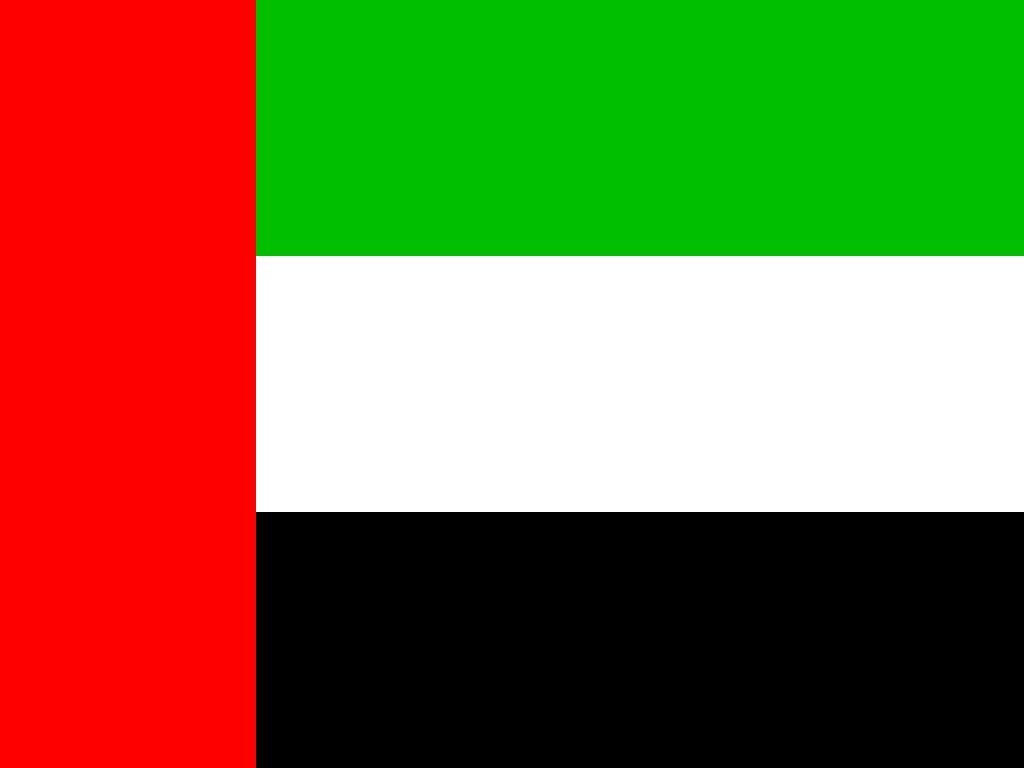
The United Arab Emirates is one of the world's fastest growing tourist and business destinations. Traditional Arab hospitality and comfortable winter temperatures are complemented by sophisticated infrastructure and world-class amenities.
The UAE also has become a world-class venue for conferences, regional and international exhibitions and major global sports events such as the Dubai World Cup for horse-racing, the Abu Dhabi Formula One Grand Prix, the Dubai Desert Classic Golf Tournament, and the Fifa Club World Cup, to be held in Abu Dhabi in 2009 and 2010.
The United Kingdom's largest online travel agent, expedia.co.uk, selected Abu Dhabi as one of the world's top 10 travel destinations in 2008. And Dubai International Airport won the award for the Middle East's leading airport in the 2007 World Travel Awards.
There is much to do in the UAE beyond Dubai and Abu Dhabi. First settled during the Bronze Age, Sharjah is the cultural capital of the emirates. The Heritage Area of Sharjah City includes a Maritime Museum, an Islamic Museum and museums for traditional and contemporary Arabic art, among many others.
Ajman attracts international visitors with beautiful beaches, as does Fujairah which also offers snorkeling and diving and excursions to the Musandam Peninsula, renowned for the unspoiled nature of its sheer cliffs, rocky coves and coral reefs
Ra's al Khaymah, on the border with Oman, is probably best known among local adventure travelers for the rugged Hajar Mountains.
History
The UAE’s rich history is rooted in trade and tied to Islam, which came to the region in AD 630. Its location between Europe and the Far East attracted merchants from India and China and was prized by Europeans, in particular the Portuguese, the Dutch and the British.
While Europeans sought control of the coasts, inland, the ancestors of the Bedouin made the sandy deserts of Abu Dhabi and Dubai their home. The town of Abu Dhabi became an important center.
In the 19th century, the British signed a series of agreements with the individual emirates that resulted in the area becoming known as “The Trucial States.” They agreed not to dispose of any territory except to the United Kingdom and not to enter into relationships with any foreign government other than the United Kingdom without its consent. In return, the British promised to protect the coast from all aggression by sea and to help in case of land attack.
The pearling industry thrived in 19th and early 20th centuries, providing income and employment to the people of the Gulf. Many inhabitants were semi-nomadic, pearling in the summer and tending date gardens in the winter. But the economic depression in the late 1920s and early 1930s, coupled with the Japanese invention of the cultured pearl, irreparably damaged the industry.
New Beginnings
In the early 1930s the first oil company teams conducted geological surveys. In 1962, the first cargo of crude was exported from Abu Dhabi. With oil revenues growing year by year, HH Sheikh Zayed bin Sultan Al Nahyan was chosen as Ruler of Abu Dhabi in 1966. He undertook a massive program of construction of schools, housing, hospitals and roads.
One of Sheikh Zayed’s early steps was to increase contributions to the Trucial States Development Fund. Abu Dhabi soon became its largest donor. In the meantime, HH Sheikh Rashid bin Saeed Al Maktoum, de facto Ruler of Dubai since 1939, developed shipping to replace pearling revenues. When Dubai’s oil exports started in 1969, Sheikh Rashid was able to use oil revenues to improve the quality of life of his people.
At the beginning of 1968, when the British announced their intention to withdraw from the Arabian Gulf, Sheikh Zayed acted rapidly to establish closer ties with the emirates. With Sheikh Rashid, Sheikh Zayed called for a federation that would include not only the seven Emirates that together made up the Trucial States, but also Qatar and Bahrain.
Agreement was reached between the rulers of six of the Emirates (Abu Dhabi, Dubai, Sharjah, Umm al-Qaiwain, Fujairah and Ajman), and the Federation to be known as the United Arab Emirates was formally established on 2 December 1971. The seventh Emirate, Ra’s al-Khaimah, acceded to the new Federation the following year.
Since then, the seven Emirates have forged a distinct national identity. The UAE’s political system combines traditional and modern and enabled the country to develop a modern administrative structure while ensuring that traditions of the past are maintained, adapted and preserved.
Government
Under the UAE system of government, the President of the Federation is elected by a body known as the Supreme Council of Rulers. The Supreme Council is the top policy-making body in the UAE, and the President and Vice President are both elected from its membership for renewable five-year terms.
The Supreme Council has both legislative and executive powers. In addition to planning and ratifying federal laws, the Supreme Council approves the President’s nominated Prime Minister and is equipped to accept his resignation, if required.
The Prime Minister is appointed by the President. He or she then appoints a Council of Ministers, or Cabinet, to oversee the development and implementation of federal policy across all portfolios of government.
In addition to the Supreme Council and the Council of Ministers, a 40-member parliament known as the Federal National Council (FNC) also examines proposed new legislation and provides advice to the UAE Cabinet, as required. The FNC is empowered to call and question Ministers in regard to their own performance, providing an additional degree of accountability to the system. Groundbreaking developments to open up decisionmaking were made in December 2006, with the first indirect election of FNC members. Previously, all FNC members were appointed by the Rulers of each Emirate.
The introduction of indirect elections represents the beginning of a process to modernize the UAE’s system of government. Under these reforms, individual Rulers select an electoral college whose members total 100 times the number of FNC members held by that Emirate. The members of each college then elect half of the FNC members, while the other half continue to be appointed by each Ruler.
The process resulted in an FNC in which one-fifth of its members are women.
Future initiatives are expected to expand the size of the FNC and strengthen the interaction between it and the Council of Ministers, to further improve the efficiency, accountability and participatory nature of government in the UAE. In November 2008, the terms for FNC members were extended from two to four years, which is more consistent with other parliaments in the world. In addition, the government will report to the FNC about proposed international treaties and agreements, and those agreements will be discussed by the FNC before their ratification.
Historically, the political environment of the UAE has been characterized by great affection for the country’s leadership and institutions of government. This is largely in response to the rapid growth and development the UAE has experienced under their guidance in recent decades.